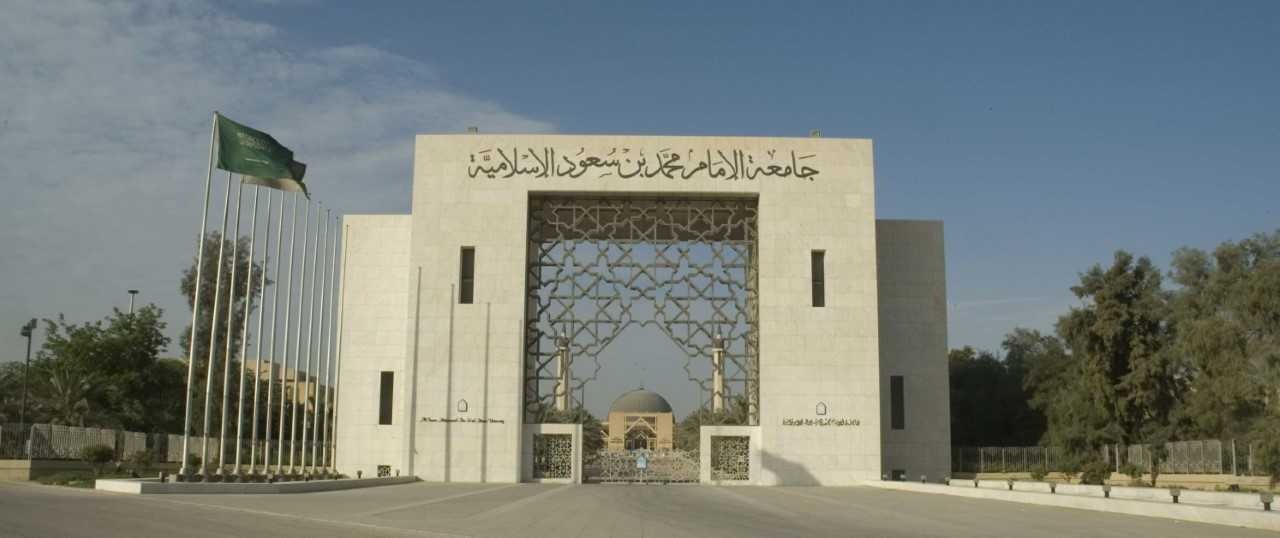
|
Vision:
Al-Imam Muhammad Ibn Saud Islamic University always is aspires to be an international famous institution of learning, education and scientific research based on the fundamental Islamic values and teachings.
Mission:
Through backing some distinct activities of learning, education and scientific research, and in lights of the Islamic teachings and values, Al-Imam Muhammad Ibn Saud Islamic University is taking care of knowledge, creativity, moral values of female and male students, and faculty staff members; so as to enable them in furnishing their leadership skills and be capable of serving the homeland. The university is, also, highly motivated in achieving the precious balance between Islamic lines and academic excellence in order to contribute strongly and mostly in building knowledge and science society.
1. The university is Sharia and intellectual high institution run according to Sharia (the Islamic Law);
2. Carrying out the academic policies and providing undergraduate and postgraduate studies;
3. Upgrading the scientific researches thru writing, translation, and publishing;
4. Serving the community within its competence.
Teaching Sharia sense prevailed most regions in Saudi Arabia before opening up government-run schools and Sharia institutes.
Teaching was conducted at mosques and houses of ulama (scholars), who taught a lot of judges. His eminence Sheikh Mohammed Ibrahim Al-Sheikh – May Allah show mercy to him - and his brothers played a significant role in disseminating knowledge of Sharia in Riyadh and the neighboring areas.
With the start of the overall Sharia knowledge rise in 1370 H (1949 G) and, thanks to turnout by the youth to learn Sharia knowledge, the administration-led King Abdulaziz - May Allah show mercy to him - opened up Riyadh Sharia Institute. The by-then king assigned Sheikh Mohammed Ibrahim Al-Sheikh, the by-then mufti of Saudi Arabia, to run the institute. It was the first beginning of Sharia institutes in different regions of the kingdom.
In 1951, college of Sharia was open in Riyadh, and in 1952, the college of Arabic language was also open. Then, a series of Sharia institutes was open under the umbrella of the General Presidency of Sharia Colleges and Institutes.
On September 10th 1974, a royal decree No. 50/m - based upon the cabinet resolution No. 1100 on September 4th 1974 - was issued to approve of the policy of Al-Imam Muhammad Ibn Saud Islamic University. As such, it is deemed a higher educational institution, comprising the higher institutes, colleges, and Sharia institutes in Saudi Arabia.
Since the university was established, it has been enlarging continually. It comprises 11 colleges, five of which are in Riyadh and six are out of Riyadh in regions of Al-Qassim, Al-Ehsa, and Medina, in addition to the southern region. Also, it comprises two institutes in Riyadh: one for Jurisdiction and one for teaching Arabic language for non-Arabic native speakers. It comprises six institutes abroad for teaching Islamic, Arab knowledge in Ras Al-Khaima, UAE, Mauritania, Djibouti, Indonesia, USA, and Japan, in addition to,sixty Sharia institutes kingdom-wide.
Thanks to the grand expansion of the university, the followingfive-year plan, was approved of to establish a university city. The project site was selected to be north of Riyadh city. Late King Fahd bin Abdul-Aziz Al-Saud, the Custodian of the Two Holy Mosques, laid down the foundation stone of the project on January 5th, 1982 G. The university has been carrying it out.
The following phases have already been executed:
1. The first phase: Student housing area.
2. The second phase: the first part of academic area.
3. The third phase: first part of services.
4. The fourth phase: the medical center and the sport area.
5. The fifth phase: the first part of faculty member housing area.
Everything was shifted to the University City in the beginning of Academic year 1411 H (1990 G). The move affected positively and mostly the educational activity on campus. The jump brought up qualitative and quantitative results on campus, institutes, supporting deanships, and other units.
Overview:
As the world grows steadily in information technology improvements and as information is critical in the decision-making process and outputs efficiency and according to the realization of Al-Imam Muhammad Ibn Saud Islamic University to hold its own development and improve online services, His Excellency Prof. Dr. Suliman Aba Al-Khail, Rector of Al-Imam University, have charged Distance Learning Deanship officially to re-invent the creative-vision wheel of the university portal so as to go side-by-side with the future informatics needs through crafting the content’s management and scientific frameworks.
Mission:
Help disseminating the orderly Sharia-based legacy derived from Glorious Quran, Sunnah and inculcated Salafi (Forefather) beliefs to all beneficiaries all around the world.
Vision:
To be number one certified and authenticated source for Islamic Sharia reference, studies and dissertations all around the world.
Objectives:
Distance Learning Deanship is intending to perform the following objectives:
1. Professional founding and availability of a centralized and secured web gateway contains all the university various departments and units for all right beneficiaries and visitors.
2. Provide a secure and unified access to all the current and future services, systems and data of the university.
3. Count, improve and automating all work procedures within and outside the university targeting to honing-up daily work production.
4. Archiving documents, data and procedures of all kinds.
5. Accessibility of online services which conformance with the university’s strategic plans and e-Government Program trends.
Portal:
Al-Imam University portal is an official umbrella for all services, systems and information of the university and it’s primarily involving four major parts:
1.1 Introduction Section:
Is the main page of the portal, in addition to the sub-sites namely:
1.1.1 Supporting Deanships Sites.
1.1.2 College and Institutes Sites.
1.1.3 Sharia Institutes Sites.
1.1.4 Faculty Staff Members Sites.
1.1.5 Departments and University Service Sites.
1.2 Scientific Section:
An enhanced publishing system could be available for all colleges, administrations, officers, tutors and students of the university so as to help them in uploading and publishing whatever they want whether through the portal or the sub-sites:
1.2.1 MA & PhD Dissertations.
1.2.2 Thesis, study papers and work papers.
1.2.3 News.
1.2.4 Researches.
1.2.5 Academic Articles.
1.2.6 Bylaws and Regulations.
1.2.7 ….. etc.
1.3 Integration with all different systems of the university achieving flow of information between the portal and these systems:
1.3.1 Administrative Systems.
1.3.2 Financial Systems.
1.3.3 Warehouses.
1.3.4 Registration and Admission Systems.
1.3.5 E-Learning systems.
1.3.6 Users’ Control systems.
Automating Work Procedures:
Count, authenticating and modifying all procedural processes throughout “Internet” and “Intranet”:
1.4 Archiving Management System.
1.5 Workflow Management System.
1.6 Integration and Conformity with “YESSER” E-Government Program.
|
|
|
|